Singapore Circuit & Road
Driving Test Guide
What to expect on test day — circuit exercises, road test assessment, demerit points, common failure reasons, and proven tips to pass your TP driving test.
The TP Driving Test – What Is It?
The Traffic Police (TP) Driving Test — formally the Practical Driving Test (PDT) — is the final assessment you must pass to receive your Provisional Driving Licence (PDL) in Singapore. It is conducted by a uniformed Traffic Police examiner and consists of two sequential parts on the same day.
The test takes place at your enrolled ADC (CDC, BBDC, or SSDC) using the ADC's own dual-controlled vehicles. The examiner sits in the passenger seat and uses a structured marking sheet to score your performance. Both parts — the Circuit Test and the On-Road Test — use a demerit point system. Certain serious offences trigger Immediate Failure (IF) regardless of demerit points accumulated.
Preparation is key. The candidates who pass on their first attempt are those who treat every training lesson seriously, practise the circuit exercises until they are automatic, and drive with confident, methodical habits throughout the road test.
Part 1: Circuit Test
Conducted inside the ADC's closed circuit. You perform a series of prescribed manoeuvres. Must pass this to proceed to Part 2. Maximum 20 demerit points allowed.
Part 2: On-Road Test
30–40 minutes on public Singapore roads. Examiner assesses real-world skills including observations, signalling, speed control, and road safety. Maximum 20 demerit points allowed.
Conducted by Traffic Police
A uniformed TP officer — not your instructor — conducts the assessment using a standardised, fair, and consistent framework across all test centres.
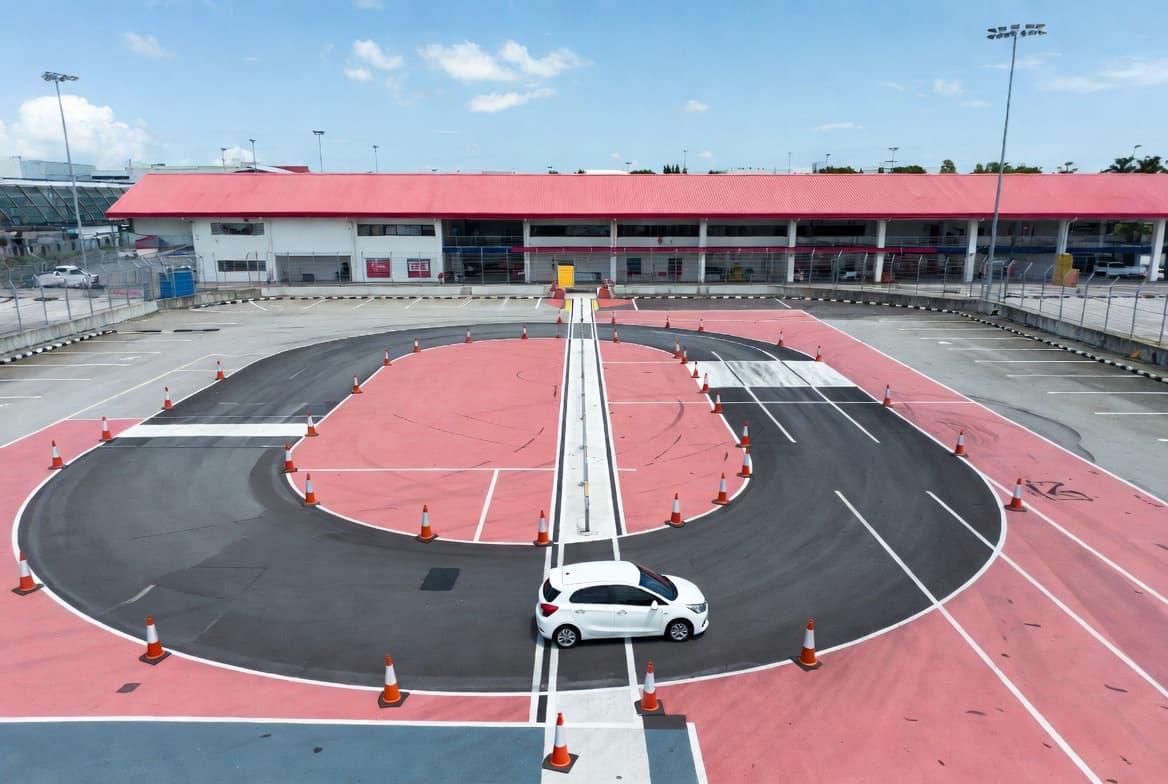
Circuit Test – 10 Mandatory Exercises (Class 3/3A)
The circuit test evaluates your vehicle control in a closed, structured environment. All exercises must be completed in sequence. Mastering each one before test day is essential.
Moving Off & Stopping (Emergency Braking)
Demonstrates your ability to move the vehicle smoothly from stationary and bring it to a controlled halt. Emergency braking tests how quickly and safely you stop when signalled. Examiners check for proper mirror checks before moving off, smooth clutch control (manual), and no over-braking or wheel lock.
Gear Changing Manual Only
For Class 3 (manual) candidates only. Tests your ability to change gears smoothly at appropriate vehicle speeds. You must demonstrate correct gear selection at different speed ranges, smooth clutch engagement, and no gear crunching. Class 3A automatic candidates are not assessed on this exercise.
Directional Change (3-Point Turn)
Reverse the vehicle's direction within a marked area using forward and reverse movements within the allowed number of moves (typically 3). Key faults include mounting the kerb, turning beyond designated lines, or failing to complete within the required movements. Smooth steering and clutch control are essential.
Parking (Parallel / Perpendicular / Vertical)
Park the vehicle in a designated bay — parallel (between two vehicles end-to-end) or perpendicular/vertical bay parking. The vehicle must end up within the painted bay lines without touching or crossing them. Proper reference points, slow speed, and full steering lock at the correct moment are critical.
Reversal Into a Lot
Reverse the vehicle into a designated parking lot from a forward-facing approach. Tests precision while reversing using mirrors and careful observation. The vehicle must finish squarely within the bay. Common faults: reversing too fast, not checking blind spots, or finishing at an angle.
S-Course (S-Bend Driving)
Drive through a winding S-shaped course marked by kerb lines on both sides without touching or crossing the kerbs. Requires precise steering and smooth controlled speed. Kerb touches earn demerit points, and mounting the kerb can result in immediate failure. Navigate the full S-bend cleanly.
Crank Course (Narrow L-Bend)
Navigate through a tight L-shaped or Z-shaped course with narrow corridors marked by kerbs. Tests your ability to handle the vehicle in very confined spaces and make sharp angle turns with precision. Slow speed and short, deliberate steering inputs are essential. Common mistake: turning too early or late, causing the rear wheel to clip the kerb.
Slope (Hill Start)
Drive up the slope, stop completely, then move off without rolling backwards. For manual: release the handbrake only as the clutch finds its biting point to prevent roll-back. For automatic: use footbrake or creep technique. Examiner marks for: stalling, excessive roll-back, or failing to stop completely before moving off.
Lane Changing
Demonstrates safe lane-changing on the circuit road. You must signal, check mirrors and blind spots (with a shoulder check), and merge into the adjacent lane smoothly. The full observation sequence — mirror, signal, manoeuvre — must be clearly visible to the examiner. Skipping the shoulder check is one of the most commonly penalised faults.
Expressway Driving Simulation
A circuit road section simulating expressway conditions. You must accelerate to appropriate speed, maintain lane discipline, demonstrate safe following distance, and exit cleanly. Prepares you for the on-road test where you may encounter actual expressway segments. Speed management and smooth acceleration are assessed.
Circuit Test Demerit Point System
Each fault is assigned a demerit point value. Minor faults carry fewer points; serious faults carry more. Accumulating more than 20 demerit points results in a fail of the circuit test.
Certain errors — including exceeding the circuit speed limit, dangerous manoeuvring, causing a collision, or severe kerb mounting — trigger an Immediate Failure (IF), ending the test immediately. If you receive an IF on the circuit, you cannot proceed to the on-road test and must rebook the full test.
On-Road Test – What the Examiner Assesses
After passing the circuit test, you drive out onto public Singapore roads with the TP examiner. This is where your real-world driving ability is put to the ultimate test.
Test Duration & Route
- Approximately 30–40 minutes of on-road driving
- Routes are set by the Traffic Police and vary by ADC location
- Covers residential roads, arterial roads, and typically an expressway segment
- The examiner gives clear, timely directions — follow them safely, not blindly
- If a direction requires unsafe driving, exercise safe judgement — you will not be penalised for safety-first decisions
What the Examiner Evaluates
Observations
Mirror checks, shoulder checks, and general scanning of the road environment
Signalling
Correct, timely use of turn signals before every manoeuvre and lane change
Speed Control
Appropriate speed for conditions, never exceeding posted limits
Lane Discipline
Correct lane positioning, no unnecessary drifting or straddling
Following Distance
Maintaining a safe 2-second (or greater) gap from the vehicle ahead
Pedestrian Awareness
Giving way at crossings, being cautious near schools and bus stops
Immediate Failure Offences (On-Road)
The following result in Immediate Failure — the test ends immediately regardless of prior performance:
- Dangerous driving that endangers the public or examiner
- Disobeying a red traffic light or stop sign
- Exceeding the posted speed limit
- Failing to give way when legally required
- Using a mobile phone while driving
- Colliding with another vehicle, pedestrian, or object
- Requiring the examiner to use the dual-control brake
On-Road Demerit Point System
You are allowed a maximum of 20 demerit points during the on-road test. Exceeding this total results in a fail.
8 Essential Test Day Tips
What you do on test day itself significantly impacts your performance. Follow these tips from experienced instructors and successful candidates.
Arrive 30 Minutes Early
Late arrival means disqualification. Arrive at least 30 minutes before your scheduled time to register, settle nerves, and do a warm-up with your instructor in the vehicle.
Bring NRIC or Passport
Your identity document is mandatory. Without it, you will not be allowed to sit the test and will forfeit the fee. Check your bag before leaving home.
Warm Up with Your Instructor
Request a 15–20 minute warm-up lesson immediately before the test. This reactivates muscle memory and refreshes circuit reference points. Never go into the test cold.
Relax and Breathe Deeply
Anxiety impairs performance. Take slow, deep breaths. The examiner follows a standardised checklist — they are neutral, not adversarial. Drive exactly as you were trained.
Exaggerate Your Mirror Checks
The examiner must see you checking mirrors. Make head movements for mirror and shoulder checks deliberate and clearly visible. Many candidates fail on observations despite checking, simply because the movement was too subtle.
Stay Within Speed Limits
Exceeding the speed limit is an immediate failure. Watch your speedometer constantly. Be slightly under the limit rather than risk going 1 km/h over. Slow down smoothly before junctions.
Don't Rush Manoeuvres
Rushing is a major test-day mistake. There is no time penalty for slow exercises — but there are penalties for kerb touches and positioning errors. Slow and deliberate beats fast and imprecise.
Signal Early – Every Time
Signal at least 3 seconds before any lane change, turn, or manoeuvre. Build an automatic habit: intention to turn → signal → check mirrors → manoeuvre. Never skip the signal step.
6 Most Common Reasons Candidates Fail
These are the faults most frequently recorded by examiners. Understanding and eliminating them will significantly improve your pass rate.
Not Checking Mirrors
What it is: Failing to visibly check rear-view and side mirrors before moving off, turning, changing lanes, or braking.
How to avoid: Make mirror-checking a habitual reflex before any speed or direction change. Exaggerate the visible head movement so the examiner can clearly see it.
Stalling the Engine
What it is: Releasing the clutch too quickly or at wrong engine speed, causing the engine to cut out — most common on the slope and when moving off from traffic lights.
How to avoid: Practice clutch control until automatic. One stall earns demerit points but is not an IF — recover calmly by restarting and continuing without panicking.
Poor Speed Control
What it is: Driving too slowly in normal conditions (causing hazards), or too quickly near junctions, crossings, or speed limit transitions — including inadvertently exceeding the posted limit.
How to avoid: Check your speedometer every 5–8 seconds. Approach all junctions and crossings with a speed reduction well in advance.
Not Signalling or Late Signals
What it is: Forgetting to signal before a turn or lane change, or signalling so late it provides no meaningful warning to other road users or the examiner.
How to avoid: Build a consistent Signal → Mirror → Manoeuvre (SMM) routine. Signal at least 3 seconds before any directional change, every single time without exception.
Kerb Mounting During Parking
What it is: Any wheel touching or mounting the kerb during parking exercises (parallel, perpendicular, reversal into lot) or while navigating the crank or S-course.
How to avoid: Use clearly defined visual reference points taught by your instructor. Practice each parking type until the reference points are second nature before test day.
Panicking on the Slope
What it is: Freezing or making hasty movements on the slope exercise — releasing clutch or brake too suddenly, causing roll-back or stalling on the incline under pressure.
How to avoid: Slow down mentally before reaching the slope. For manual: find the bite point, then release the handbrake smoothly. For automatic: use footbrake creep technique. Practise until mechanical.
After the Test – What Happens Next?
Whether you pass or fail, here is exactly what comes next and what steps to take.
If You Pass
- Your Provisional Driving Licence (PDL) is issued through the LTA system
- PDL is valid for 1 year from date of issue
- Display a red P-plate on front and rear at all times
- Maximum speed of 70 km/h applies at all times
- Demerit point threshold is 13 points (vs 24 for full licence holders)
- After 1 year of clean, accident-free driving, your licence is automatically converted to a full driving licence
- LTA will notify you — remove your P-plates and enjoy full driving privileges
If You Fail
- A mandatory cool-off period applies before rebooking — check with your ADC for current wait times
- Review the examiner's feedback sheet carefully to identify specific faults
- Take additional lessons targeting the exact weaknesses recorded
- Pay the TP test fees again on rebooking ($35.60 circuit + $65.50 on-road for Class 3)
- There is no limit on how many times you can retake the test
Key advice: Do not rebook until the specific faults identified are significantly improved. Each fault on the marking sheet is a direct study target.
Motorcycle Circuit Test – Class 2B, 2A & 2
The motorcycle TP test follows the same two-part structure (circuit then road) but with different exercises tailored to two-wheeled vehicles and unique balance and control challenges.
Slow Riding – Balance Beam
Ride across a raised balance beam at very slow speed without putting your feet down. Tests fundamental balance and low-speed control. A foot-down is an immediate fail for this exercise.
Demerit note: Any foot placed on the ground during this exercise results in immediate failure of the exercise, earning significant demerit points.
Figure-8 Course
Ride in a figure-8 pattern within marked boundaries at slow speed. Tests controlled steering and balance around tight turns. Complete the full figure-8 without touching boundary lines or putting feet down.
Tip: Look ahead toward your exit path — not at where you are currently steering. Your body will follow your eyes.
U-Turn
Perform a U-turn within a designated area without crossing boundary lines. Requires precise throttle and steering control. The turning radius must be tight enough to complete the U-turn within the marked zone.
Tip: Maintain a slow, consistent throttle throughout the turn. Do not brake mid-turn as this can cause instability.
Emergency Braking
Accelerate to a specified speed then bring the motorcycle to a full stop within a marked braking zone when signalled. Braking distance must be within limits, and the motorcycle must stop in a straight line without skidding or losing balance.
Demerit note: Skidding, swerving while braking, or stopping beyond the braking zone each earn demerit points.
Slope (Hill Start)
Ride the motorcycle up a gradient, stop completely, then move off without rolling back. Requires careful coordination of throttle, clutch, and rear brake. No roll-back and a clean, smooth departure from the incline are required.
Tip: Use the rear brake as your primary hold on the slope while finding the clutch bite point before releasing.
Swerving Course
Ride at a specified speed and swerve to avoid simulated obstacles (cones or markers). Tests your ability to react quickly and safely to unexpected road hazards without hitting markers, losing control, or putting a foot down.
Demerit note: Hitting a cone, applying brakes during the swerve, or losing balance each earn demerit points.
Motorcycle Demerit Thresholds & Licence Upgrades
Motorcycle candidates operate under a demerit point system with thresholds and allocations tailored to two-wheeled vehicle control. Immediate failure (IF) offences are the same in principle — dangerous riding, falling off the motorcycle, exceeding speed limits, or requiring examiner intervention.
Class 2B holders who wish to upgrade to Class 2A (up to 400cc) or Class 2 (unlimited cc) must pass a separate additional TP riding test for each upgrade. Each class has its own required training hours and test criteria before the upgrade test can be attempted.
Frequently Asked Questions
Common questions about the Singapore circuit and on-road driving test.